Ancestral Healing
Wolof Wisdom on the Body: Lessons from West African Healing Traditions
Aja Diack ·
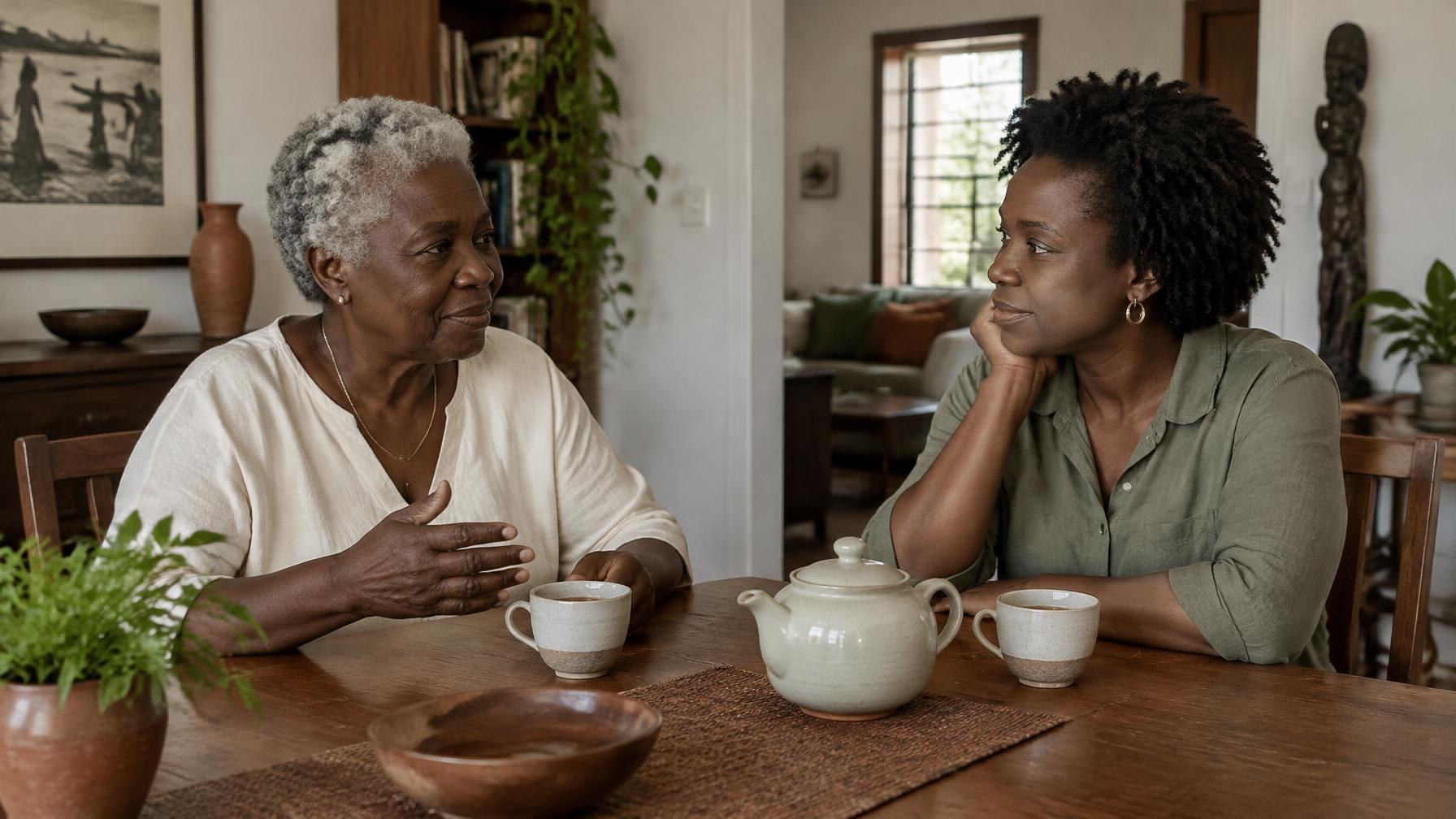
In Wolof, the language of Senegal and of my own lineage, there is an understanding that lives in the way elders speak of health and illness, an understanding so woven into ordinary conversation that most people who grew up inside it never think to name it as a philosophy at all. The body is not a machine that breaks down and gets repaired. It is a living record of everything the person has experienced, absorbed, resisted, and carried.
This is not poetry, even though it sounds like it. It is a sophisticated framework for understanding human health that long predates the clinical models more familiar in the West, and that, in many ways, is more complete than what replaced it.
I did not learn this framework from a textbook. I learned it the way most of us learn the deepest things, by watching. By listening to the way my elders asked about a person's health. By noticing what questions came first, and what those questions revealed about what they believed was actually happening inside a body that had stopped functioning the way it should.
West African healing traditions, and Wolof wisdom in particular, offer a way of understanding the body that the women of our lineage have always known, even when history did everything in its power to make them forget it, or to make their daughters ashamed of remembering it. Returning to this understanding is not nostalgia. It is medicine.
The Body as Sacred Vessel
In many West African traditions, the body is understood as a vessel held in relationship with the spirit, the community, and the ancestors. Illness, in this framework, is not simply a malfunction to be corrected. It is often a communication, an expression of imbalance that may be physical, emotional, relational, or spiritual, and that requires attention at each of those levels to be truly addressed.
This means that when a woman is unwell, the healer does not only ask what is wrong with her body. She asks what is happening in her life. What losses has she sustained? What relationships are in discord? What is being called forward in her that she has not yet answered? Is there a grief she has not been given room to grieve? Is there a truth she has been swallowing to keep the peace in her household?
I have watched this kind of questioning happen. It is slow. It is not efficient in the way a fifteen minute appointment is efficient. But it is thorough in a way that most modern medical encounters never have the time to be. The healer is not simply trying to name a diagnosis. She is trying to understand a life.
This is not the replacement of physical care. I want to be clear about that, because it would be easy to romanticize this tradition into something it is not. Wounds still needed tending. Fevers still needed cooling. This is the expansion of physical care, the insistence that the body cannot be fully understood in isolation from the life that moves through it.
What the Elders Meant When They Asked How Your Body Was Speaking to You
There is a particular question that used to circulate among the women in my family, one that does not translate cleanly into English no matter how many times I have tried. It is closer to asking, what is your body telling you today, than it is to asking, how are you feeling.
The difference matters. How are you feeling invites a report. What is your body telling you invites a translation. It assumes the body already knows something, and that your job, and the healer's job alongside you, is simply to listen closely enough to hear it.
This reframes illness entirely. A headache is not simply a headache to be silenced with the nearest remedy. It might be a message about tension you have been carrying in your jaw and your shoulders without naming it. A digestive complaint is not simply a digestive complaint. It might be a message about something you have swallowed, literally or figuratively, that your body no longer wants to hold.
I do not say this to suggest that every physical symptom is purely symbolic, or that real medical attention should ever be delayed in favor of interpretation. That would be its own kind of harm. What I am describing is a posture, a way of approaching the body with curiosity rather than only with the urge to fix. Modern wellness culture has become very good at optimizing the body and not nearly as good at listening to it.
Plant Medicine as Ancestral Relationship
In Wolof tradition, as in many West African healing systems, plants are not merely chemical compounds waiting to be extracted and standardized. They are beings with intelligence and intention, and the relationship between healer and plant is one of respect and reciprocity, not simply extraction.
This understanding shapes not only which plants are used, but how they are used. The intention behind the preparation matters. The words spoken over the medicine matter. The gratitude offered to the plant, before it is harvested and after it is consumed, matters. There is a way of gathering a leaf that honors the plant it came from, and a way that simply strips it. Our grandmothers knew the difference in their hands before anyone ever explained it to them in words.
For women navigating modern life, reconnecting with plant medicine through this lens, rather than simply as supplementation to be tracked and optimized, can transform the entire experience of taking care of oneself. The morning cup of bissap becomes a ritual of connection rather than a task on a wellness checklist. The addition of moringa to a meal becomes an act of ancestral acknowledgment rather than a nutrient you are trying to hit for the day. These are not small things, even though they can look small from the outside.
I think often about how differently my body responds to something I have prepared slowly, with attention, than to something I have consumed quickly, on the way to somewhere else, thinking about everything except what I am putting into myself. The plant may be chemically identical in both cases. The experience of receiving it is not.
The Difference Between Treating and Listening
Modern medicine, at its best, is extraordinary at treating. It can identify a pathogen, isolate a deficiency, correct an imbalance with remarkable precision. I do not romanticize the past in a way that dismisses what this precision has made possible. Women in my own lineage did not have access to the interventions that would have saved some of their lives. I do not take that lightly.
But treating and listening are not the same skill, and a system built almost entirely around the first has left many of us without the second. We can walk into an appointment, receive a prescription, and walk out having never once been asked what is actually happening in the rest of our lives. We can spend years managing symptoms that never fully resolve because nobody, including us, ever asked what those symptoms were trying to say.
Wolof healing wisdom insists on both. Treat what needs treating. And also listen, patiently, to what the body is communicating beneath the symptom. This is not an either or. It never was. Somewhere along the way, in the process of modernizing and professionalizing healing, the listening got quietly dropped because it was harder to standardize, harder to bill for, harder to fit into a system built for volume rather than depth.
Community as Medicine
One of the most significant elements of West African healing that is largely absent from modern wellness frameworks is the understanding that community is not supplemental to healing. It is central to it.
The village, the circle of women, the gathering of elders, these were not social niceties layered on top of the real medicine. They were health infrastructure in their own right. Isolation was understood as dangerous, not only emotionally but physically. Belonging had a direct, measurable relationship to wellbeing, long before modern research began publishing studies confirming what had always been common knowledge.
Your free 7-day Queen Reset guide. Get the free guide
A woman recovering from childbirth was not left alone to figure it out. A woman grieving was not expected to grieve privately, on her own schedule, without disruption to everyone else's routine. A woman navigating any major transition was surrounded, fed, checked on, held accountable to rest even when she did not think she needed it.
For women who have been navigating their health in isolation, dealing with perimenopause alone, processing grief alone, building new identities alone, often because distance or displacement or simply the pace of modern life left them without the circle their grandmothers would have had, this is a direct invitation. The medicine your body may be asking for is not always another supplement, another protocol, another thing to optimize alone in your own kitchen at midnight. Sometimes it is connection. Sometimes it is simply being witnessed.
What Gets Lost in Translation, and What Doesn't Have To
I want to be honest about something. A great deal was lost in the process of displacement, of colonization, of generations of families moving further and further from the specific soil and specific elders who carried this knowledge in unbroken lines. Some of what I am describing here exists more as a felt orientation passed down through fragments than as a complete, intact system any of us can fully access anymore.
I do not say this to discourage you. I say it because I think honesty matters more than a tidy, uncomplicated story about ancestral wisdom waiting perfectly preserved for us to simply pick back up. It is not perfectly preserved. Some of it we are reconstructing. Some of it we are guessing at, with humility, doing our best with what survived.
But the orientation itself, the posture of listening to the body as a communicator rather than only a machine, the understanding that healing happens in community rather than only in isolation, the respect for plant medicine as relationship rather than only as extraction, these did not require perfect preservation to remain available to us. They require only our willingness to turn toward them again.
Why This Matters Now, Specifically
I think this wisdom matters with particular urgency for women of the diaspora right now, in this specific moment. So many of us are navigating health seasons, perimenopause, chronic stress, the accumulated weight of caretaking, in cultural and medical systems that were not built with our bodies or our histories in mind. We are told, often correctly, that we are more likely to be dismissed, more likely to have our pain underestimated, more likely to leave an appointment with a prescription and no real sense of being understood.
Against that backdrop, returning to a framework that insists your body is worth listening to, that your life circumstances are relevant to your health, that community is not a luxury but a form of medicine, is not simply a nostalgic exercise. It is a corrective. It restores something that the systems many of us rely on for care were never designed to offer in the first place.
I do not say this to suggest we should reject modern medicine, which I want to state plainly and repeat, because I never want this kind of writing to be misread as discouraging anyone from seeking the care they need. I say it because I believe the two can, and should, exist alongside each other. Modern medicine treating what needs treating. Ancestral wisdom restoring the listening, the community, the reverence for the body as more than a mechanism, that got quietly dropped along the way.
Returning to This Wisdom
You do not need to have grown up in Senegal, or to speak Wolof, or to have had these traditions transmitted to you directly through an unbroken line of elders. The ancestral wisdom of your lineage does not require your proof of it to be available to you.
It asks only your willingness to turn toward it. To slow down enough to listen, in a culture that rewards speed and treats slowness as a failure of productivity. To honor the ways of knowing that survived the middle passage, the colonial disruption, the erasure attempts of history, and are still here, still speaking, quietly, waiting for someone to lean in close enough to hear them again.
Your body knows this language, even if your mind has forgotten it. You may simply need a little time, and a little quiet, to remember.
Learning to Ask the Question Yourself
You do not need a healer sitting across from you to begin practicing this posture. You can learn to ask yourself the questions our elders once asked on our behalf, though it takes a certain willingness to sit with your own answers honestly, without rushing past them toward a solution.
When something in your body flares, before reaching for the nearest remedy, try asking what else is true right now. What have you not said out loud this week that needed saying? What relationship has felt heavier than usual? What have you been carrying alone that was never meant to be carried alone? These are not diagnostic questions in the clinical sense. They are relational questions, the kind our grandmothers asked without needing a framework to justify asking them.
I have found, in my own life and in the lives of women I work with, that these questions rarely produce an immediate, tidy answer. More often they produce a kind of recognition, a quiet nod to something you already knew but had not let yourself say plainly. That recognition is not nothing. It is often the first real step toward whatever healing actually needs to happen, physical or otherwise.
A Practice for This Week
If you want somewhere to begin, try this. Once this week, before you reach for a remedy, a supplement, or even a piece of advice, pause and ask your body directly, what are you telling me right now. Not what is wrong with you, but what are you telling me.
Sit with whatever answer surfaces, even if it feels vague or incomplete. You do not have to solve it in that moment. You are simply practicing the posture of listening, rebuilding a muscle that modern life has let atrophy in most of us.
This is not a replacement for care you actually need. It is a companion to it, a way of bringing back a kind of attention our lineage always understood as part of what it means to be well.
If you try this even once, notice what it feels like simply to be asked the question, by yourself, with real attention, rather than rushing straight to a fix. That feeling, however small it seems, is the beginning of a very old kind of medicine finding its way back into your life.
---
If you are ready to explore what it means to heal from your roots, I would be honored to walk alongside you. Book a free discovery call and let us begin.