Wisdom
The Lie About Strong Women
Aja Diack ·
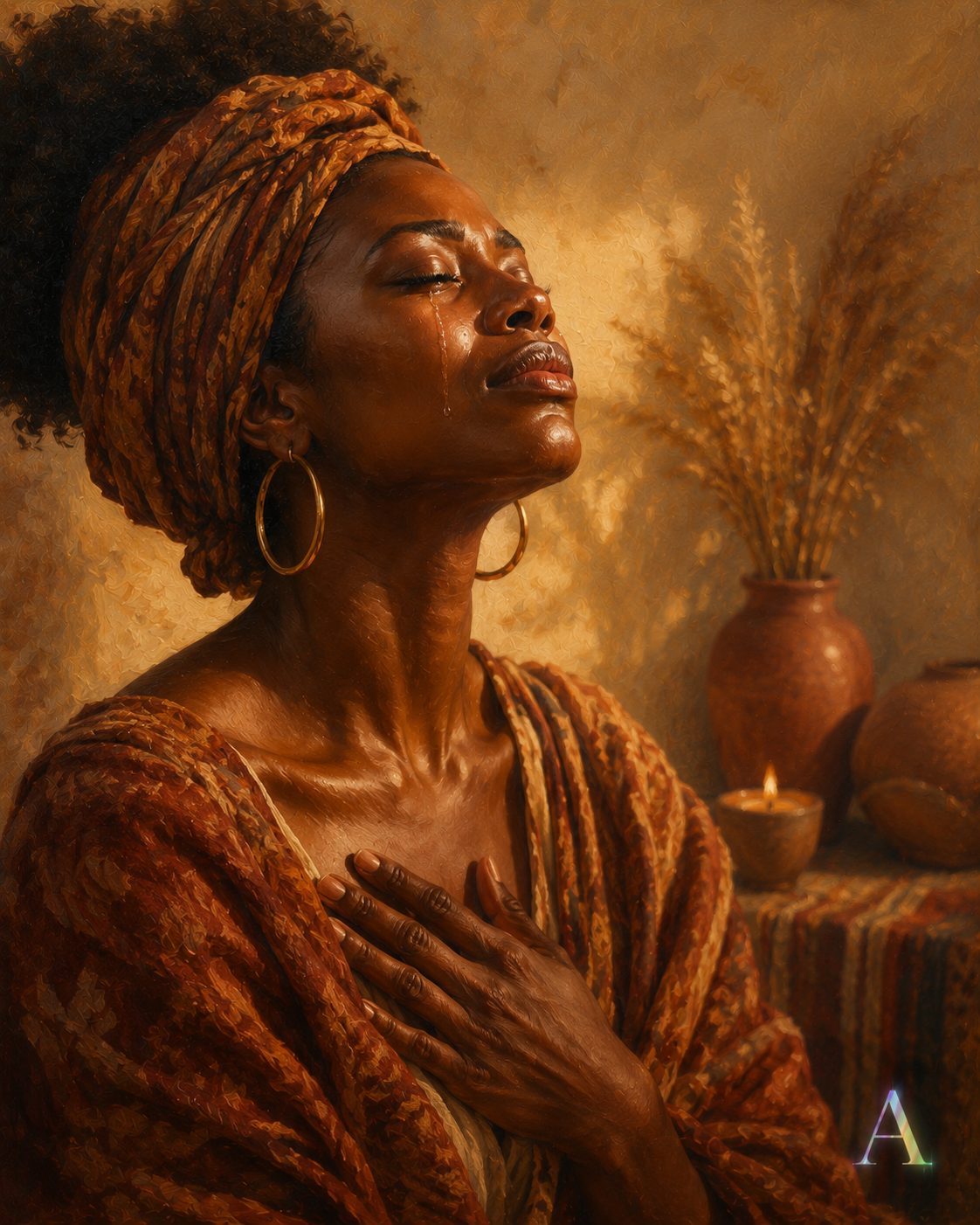
There is a story most of us were handed before we were old enough to question it. The story of the strong woman. The one who does not break, does not bend, does not ask. The one who holds the family, the home, the community, the grief, the money, the meals, the memory. The one who is admired precisely because she does not seem to need what everyone else is allowed to need.
We were told this was who we are. I want to gently suggest it was who we had to become.
Strength as Strategy, Not Nature
The strong Black woman was not born whole from some ancestral personality trait. She was shaped, generation by generation, by conditions that demanded she become unshakable in order for the people around her to survive.
Think about what our foremothers were asked to carry. Displacement. Labor that was never theirs to choose. Children born into a world that would not soften for them. Losses no one was permitted to name out loud. In that context, softness was not safe. Tears could cost you your children. Rest could cost you your life. Asking for help could cost you everything you had managed to protect.
So the softness went underground. Not because it was not there, but because there was nowhere safe to put it. What the world saw was the woman who held. What the world did not see was everything she was holding.
This is not a flaw in our lineage. This is a testament to it. Our grandmothers were engineers of survival. They built a self that could withstand what should never have been asked of anyone. That self kept us alive. That self is the reason we are here reading these words.
And still, a survival strategy is not the same thing as a soul.
The Cost of Carrying What You No Longer Need To
The trouble comes when the danger passes and the armor stays.
The conditions our great-grandmothers faced are not the conditions most of us are living inside today. This does not mean the world is easy, or safe, or fair. It means the specific shape of the threat has shifted, and the strategy shaped for that older threat is still running quietly in the background of our nervous systems, deciding what we are allowed to feel and who we are allowed to be.
You may notice it as the inability to rest even when your body is asking. The reflex to say you are fine when you are not. The way help feels dangerous to receive. The way tenderness from another person can make you tense before it makes you soft. The way you keep showing up for everyone, and quietly wonder who is showing up for you, and then talk yourself out of the question.
None of this is weakness. All of it is the old strategy doing exactly what it was built to do. Protecting you from a danger that has, in most rooms of your life, already passed.
The cost of carrying armor you no longer need is not obvious at first. It shows up slowly. In exhaustion that sleep does not touch. In a body that starts speaking in symptoms because words were not welcome. In relationships that stay at a certain depth and go no deeper. In a life that looks capable from the outside and feels lonely from the inside.
The strong woman story does not fail because it was wrong. It fails because it was designed for a season we are no longer living in.
Softness Is Not the Opposite of Strength
Somewhere along the way we were taught to hear softness as weakness. As vulnerability in the fragile sense. As a thing that gets you hurt.
I want to offer another way of hearing it.
Softness is what strength looks like when it is no longer defending itself. It is the woman who can say I am tired without apologizing for it. The woman who can receive a compliment without deflecting it. The woman who can let her child see her cry and trust that this will not undo them. The woman who can ask for help and not experience the asking as a failure.
That is not less strength. That is strength that has stopped bracing. Strength that has room to breathe. Strength that trusts itself enough to unclench.
The women in our lineage who were most alive were often the ones who kept a private softness intact, no matter what the outside required of them. A quiet kitchen at dawn. A song hummed under the breath. A hand on the small of a friend's back that said everything the moment could not. They knew, even without saying it, that the armor was for the world and the softness was for the soul, and both were sacred.
Start choosing yourself, one day at a time. See the Mini Starter Kit
We have permission to inherit both.
Examining What Was Handed to You
There is a difference between honoring your lineage and being ruled by it.
Honoring it means understanding why the women before you became who they had to become. Sitting with the conditions. Feeling the weight. Letting yourself be moved by what they carried so that you could exist. This is holy work.
Being ruled by it means never asking whether the strategy still fits your life. Wearing the armor into rooms that do not require it. Passing the same tension down to your daughters and calling it heritage when it is actually residue.
You are allowed to examine what you were given. You are allowed to keep what still nourishes you and to gently set down what no longer does. This is not betrayal. This is the exact reason your foremothers endured what they endured. So that one of us, somewhere down the line, would have the safety and the stillness to ask the question they could not afford to ask.
What in me is truly mine, and what in me is the shape of what my grandmothers had to be to keep us alive?
That question, asked slowly and without judgment, is one of the most tender inheritances you can offer the women who come after you.
What It Looks Like to Put It Down
Putting down the strong woman story does not mean becoming someone else. It does not mean stopping caring for the people you love. It does not mean the strength leaves you.
It means the strength stops costing you your body.
It looks like sitting down when you are tired instead of pushing through. It looks like letting a friend bring you soup and not turning it into a debt. It looks like crying in front of someone who has earned the right to see you cry, and letting them stay. It looks like a morning where you do not perform being okay before you have actually checked whether you are.
It looks like softness practiced in small, quiet ways, until your nervous system begins to trust that softness will not be punished this time.
It looks like telling your daughter that she does not have to be strong to be loved by you. That she was loved before she could carry anything at all.
A Slow Return
None of this happens in a weekend. The strong woman was built over generations, and she will not be laid down in an afternoon. This is a slow return, and it deserves to be slow.
You are not doing it wrong if the softness feels unfamiliar. You are not failing if the armor comes back on some days without asking your permission. You are simply a woman with a very old inheritance, learning in real time what belongs to you and what was only ever loaned to you by circumstance.
The women who came before you did not survive so that you could keep suffering in their memory. They survived so that one day one of their granddaughters could exhale.
Let it be you.
A Reflection to Sit With
What version of the strong woman story are you still carrying, and what would it mean, quietly and without announcement, to put a small piece of it down this week?