Ancestral Wisdom
Letters to My Ancestors: The Healing Practice Every Woman Should Try
Aja Diack ·
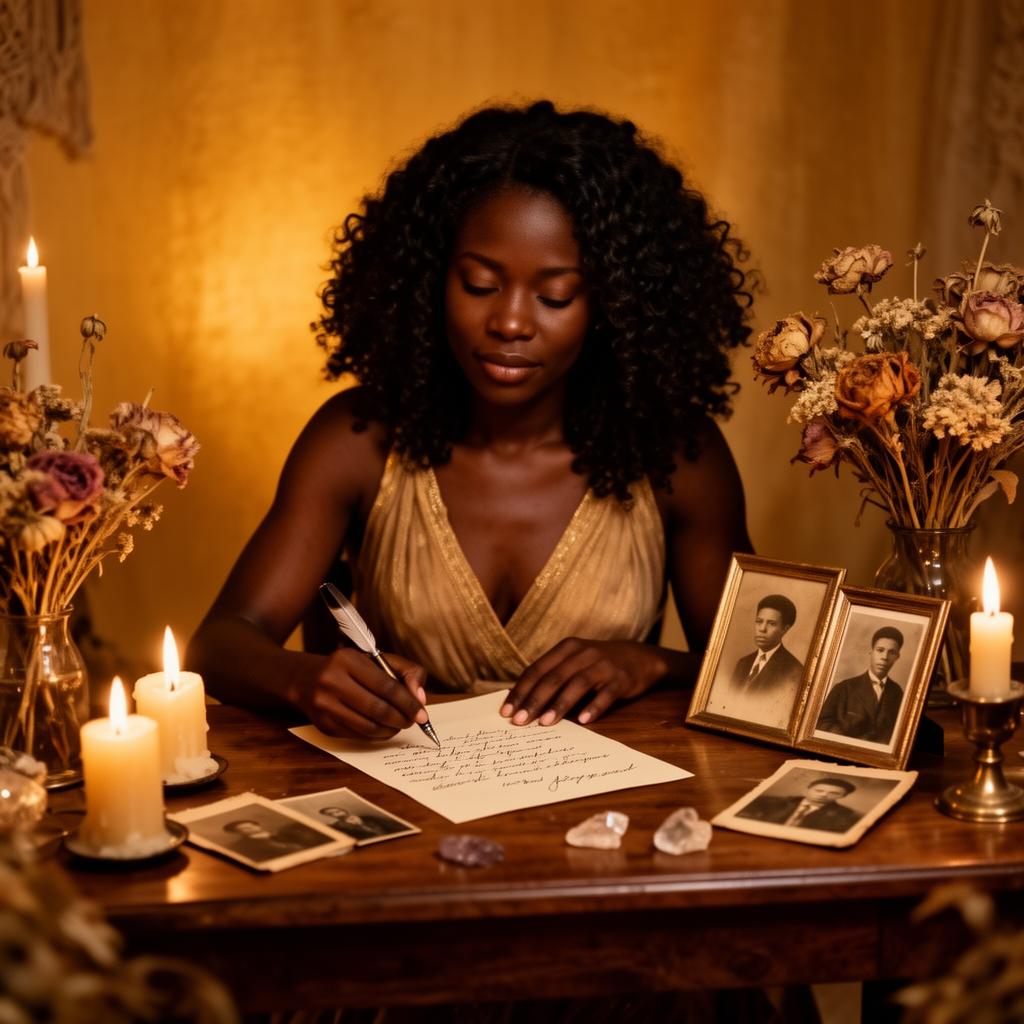
There is a moment, and perhaps you have felt it, when the weight of everything you carry becomes almost unbearable. Not because you are weak, but because you have been strong for so long that your body no longer remembers what it feels like to be held.
I know this moment intimately. I have sat on the edge of my bed at 2 a.m., tears streaming, feeling a grief I could not name. A longing for something I had never lost. A homesickness for a place I had never been. It was during one of those nights, in the middle of a season that was breaking me open, that I first picked up a pen and wrote to my grandmother. Not the living one. The one I never met. The one whose name I carry in my bones.
That letter changed something in me that years of searching had not touched.
In those moments of fracture and becoming, I have found one practice that reaches deeper than meditation, deeper than therapy, deeper than any self-help book on my shelf.
I write letters to my ancestors.
Not metaphorically. Not as a creative exercise. I sit down with paper and pen, and I write to the women and men who came before me. The ones whose names I know and the ones whose names were lost to time. And something shifts. Something opens. Something heals.
Why This Practice Matters Now
We live in a world that moves fast. We are expected to process grief quickly, move through transitions efficiently, and heal on a timeline that has nothing to do with our actual needs.
But our bodies remember what our minds try to forget. The stress we carry is not only ours. Researchers in epigenetics are studying whether the effects of severe stress can echo across generations, and that question is still open. What many of us know from our own families is simpler: patterns get passed down, in habits, silences, and ways of surviving. The anxiety you feel may not have started with you. The hypervigilance, the need to control, the difficulty trusting. These may be ancestral patterns, survival strategies that kept your grandmother alive but no longer serve you.
This is why sometimes you feel things you cannot explain. Emotions that do not fully belong to your current life. A sadness that arrives without warning. A tightness in your chest when someone raises their voice. A refusal to rest, even when your body is begging you to stop. These are not flaws. They are echoes. And they deserve to be heard.
This is not just emotional work. This is generational healing.
Writing to your ancestors is one way to begin untangling what is yours from what you inherited. It is a way to honor the survival strategies that brought you here while gently releasing the ones that are holding you back.
The Power of the Written Word
There is something about putting pen to paper that changes the way we process emotion. Typing is efficient, but handwriting is intimate. It slows you down. It forces you to stay with each word, each feeling, each breath.
When you write a letter to someone who has passed, or someone you never met, you are not expecting a reply. And that freedom is extraordinary. You can say the things you have never said. You can ask the questions you have always carried. You can express gratitude, anger, confusion, or love without the need to manage anyone else's response.
This is not about perfection. There is no right way to write these letters. There is only your way. Raw, honest, and sacred.
How to Begin: A Sacred Practice
This is not just writing. This is a return.
Find a quiet space, one that feels like it could hold something tender. Light a candle if that feels right. Place a photograph of an ancestor nearby, or simply hold them in your heart. If you have sage, palo santo, or incense, let the smoke clear the space around you. You are creating a threshold between the everyday and the eternal.
Take three deep breaths. Feel your feet on the ground. Feel the weight of your body in the chair. Close your eyes for a moment and whisper, aloud or within, I am here. I am ready to listen. You are not alone in this moment, even if it feels like you are. And then begin.
Step 1: Choose who you are writing to.
It might be a grandmother you knew well. It might be a great-great-grandmother whose name you have never heard. It might be the collective, all the women who came before you. Trust your instinct. Your spirit already knows who is waiting.
Step 2: Start with "Dear..."
Begin simply. You do not need an elaborate opening. Just their name, or "Dear Ancestor," or "Dear Grandmother I never met." Let the words find you.
Your free 7-day Queen Reset guide. Get the free guide
Step 3: Write without editing.
Do not worry about grammar, spelling, or whether it makes sense. This is not a performance. This is a conversation with your lineage. Let the pen move. Let the tears come if they come. Let the silence sit if it sits.
Step 4: Close with intention.
When you feel complete, close the letter with whatever feels true. It might be "Thank you." It might be "I forgive you." It might be "I am carrying your strength." It might simply be "I see you." Then sit for a moment in the stillness. Let the words settle into the space between worlds.
Three Prompts to Get You Started
If you are unsure where to begin, try one of these:
- "Dear Grandmother, there is something I need you to know..."
- "Dear Ancestor, I want to understand why..."
- "Dear [Name], I am ready to release..."
What Happens When You Write
I will not promise you a mystical experience, though many women describe exactly that. What I will promise is this: something shifts.
You may feel lighter. You may cry in a way that feels like relief rather than sadness. You may suddenly understand something about yourself that has been a mystery for years. You may feel held, not by anyone visible, but by something deeper and older and wider than you can explain.
Some women burn their letters after writing them, releasing the words into the universe. Some keep them in a sacred box. Some tuck them into the pages of their journals. There is no wrong choice.
This Is Your Remembering
Letter-writing as a healing practice is not new. Across African and diaspora traditions, communication with ancestors has always been central to spiritual life. We poured libations. We spoke their names. We asked for guidance and gave thanks for protection.
What I am inviting you to do is not something foreign to your lineage. It is something that was always yours. It is not a discovery. It is a remembering. A reclaiming. A return to the woman you were always meant to become.
In a world that constantly asks you to look forward, to hustle, to optimize, this practice asks you to look back. Not with nostalgia, but with reverence. Not to stay in the past, but to draw strength from the roots that hold you.
You are not starting from nothing. You are continuing a legacy. Every word you write is proof that the lineage survived. That you survived. That the women who prayed for your existence did not pray in vain.
Your Invitation Home
You do not need to wait for the right moment. You do not need permission. You only need your honesty, your breath, and a willingness to sit with something larger and older than yourself.
Your ancestors survived so that you could exist. They endured what was unendurable so that you might one day sit in a warm room and write them a letter. Honor that. Honor them. Honor yourself.
If you feel called to begin this practice, I created Letters to My Ancestors as a sacred space to hold your words, your healing, and your return. This is where your story meets your lineage, one letter at a time.